Regional Economic Development

HIA congress warns 'business barriers to construction' must be removed

THE Housing Industry Association’s (HIA) National Policy Congress (NPC) has issued a clear warning that housing supply will continue to suffer unless governments remove barriers to construction and avoid policy settings that undermine investment.

The discussions drew the overall conclusions that housing delivery is under pressure from all sides — rising costs, global uncertainty, workforce shortages and an increasingly complex regulatory environment.

The NPC – made up of elected representatives from regions across Australia, together with the chairs of HIA’s eight specialist committees, staged its annual meeting on the Gold Coast on April 16. 
The industry has come from the summit united in its view that the only sustainable solution to Australia’s housing crisis is to build more homes – and that requires policies that support investment, productivity and confidence.

A range of emerging national policy issues were highlighted at the congress. 

 
International conflict and housing
The NPC reaffirmed its concern that ongoing international conflict continues to pose risks to residential construction activity in Australia. These risks include increased costs of materials, extended construction timeframes and greater uncertainty across housing markets.
With much of the residential building industry operating under fixed‑price contracts, builders — and the trades and product suppliers that rely on them — are exposed when costs increase unexpectedly.
This reinforces the need for all levels of government to avoid introducing policies that would further impede housing delivery, including additional taxation, regulatory burdens or administrative delays.
 
Taxation policy needs work
Members reaffirmed the residential construction industry’s strong opposition to changes to the taxation system that would de-incentivise investment in new housing.
The congress noted that more than 40% of new homes were financed by investors.

Recent independent research indicates that increasing capital gains tax, when applied to establishing housing only, will reduce investment in new home supply. Improving the supply of housing requires more investment in new home supply, not less.
 
Construction Code should be overhauled and modernised

The NPC recognised that Australia has a once-in-a-generation opportunity to reform the National Construction Code (NCC), which is the cornerstone document governing home building.
The NCC has become overly complex and has been tasked to solve an expanding number of policy issues. As a result, it is no longer fit for purpose.

Builders are strongly of the view that the time is right for a complete knock-down rebuild to restore it as a world leading code.
For those states implementing NCC 2025, NPC reaffirmed the position that the industry “needs room to breathe” from any further regulatory changes, and any changes should not occur until at least May 1, 2027.

Equally, any changes to workplace exposure standards for silica should be delayed. Furthermore, new building policy must evolve to keep pace with a range of changes, threats and opportunities.


AI comes into the residential building industry
The NPC recognised that artificial intelligence (AI) has an important role to play in enhancing productivity across the residential building industry.

AI has the potential to improve business operations and workplace practices, deliver on‑site efficiencies, achieve cost savings, and strengthen supply‑chain outcomes through more effective sourcing and use of products and services.
As AI technologies evolve rapidly, governments must strike an appropriate balance between protecting privacy and intellectual property and ensuring that innovation is not unintentionally constrained.

Over‑regulation risks limiting the industry’s ability to adopt new technologies that can help address skills shortages and improve productivity.
 
Values Statement for the residential building industry
The NPC unanimously agreed to adopt a Values Statement for its members and the broader sphere of influence within the residential building industry.
The Values Statement articulates a set of core beliefs and principles intended to guide behaviour and decision‑making, and to inform how the industry operates and engages with stakeholders.

The congress agreed that a clearly defined values framework would be beneficial to industry participants, the community and governments.
The statement is underpinned by eight core principles designed to guide decision‑making, reinforce lawful and acceptable conduct, build trust, strengthen professionalism, promote ethical behaviour, and improve safety and building performance outcomes.
 
Circular economy

The NPC noted the emergence of the circular economy – an environmental concept aimed at maintaining the value of materials for as long as possible across all phases of their life cycle.
The Federal Government’s net zero plan foreshadows increased adoption of circular economy principles, including targets to reduce material footprints, lift materials productivity and increase resource recovery.

The congress affirmed that the industry does not support circular economy principles being imposed as mandatory requirements in the design, manufacture or demolition of buildings. “Any targets must not compromise the primary objectives of the National Construction Code and relevant Australian Standards relating to life safety, nor undermine housing supply or affordability,” a HIA spokesperson said.
“Policies affecting building products must preserve consumer and industry choice in materials and building solutions.

“Frameworks and regulations must recognise competing performance objectives, the high operational energy efficiency of new homes, and regional and geographical considerations that require flexibility in product selection.”

www.hia.com.au

ends

New home sales maintain momentum, up 17% in March - HIA

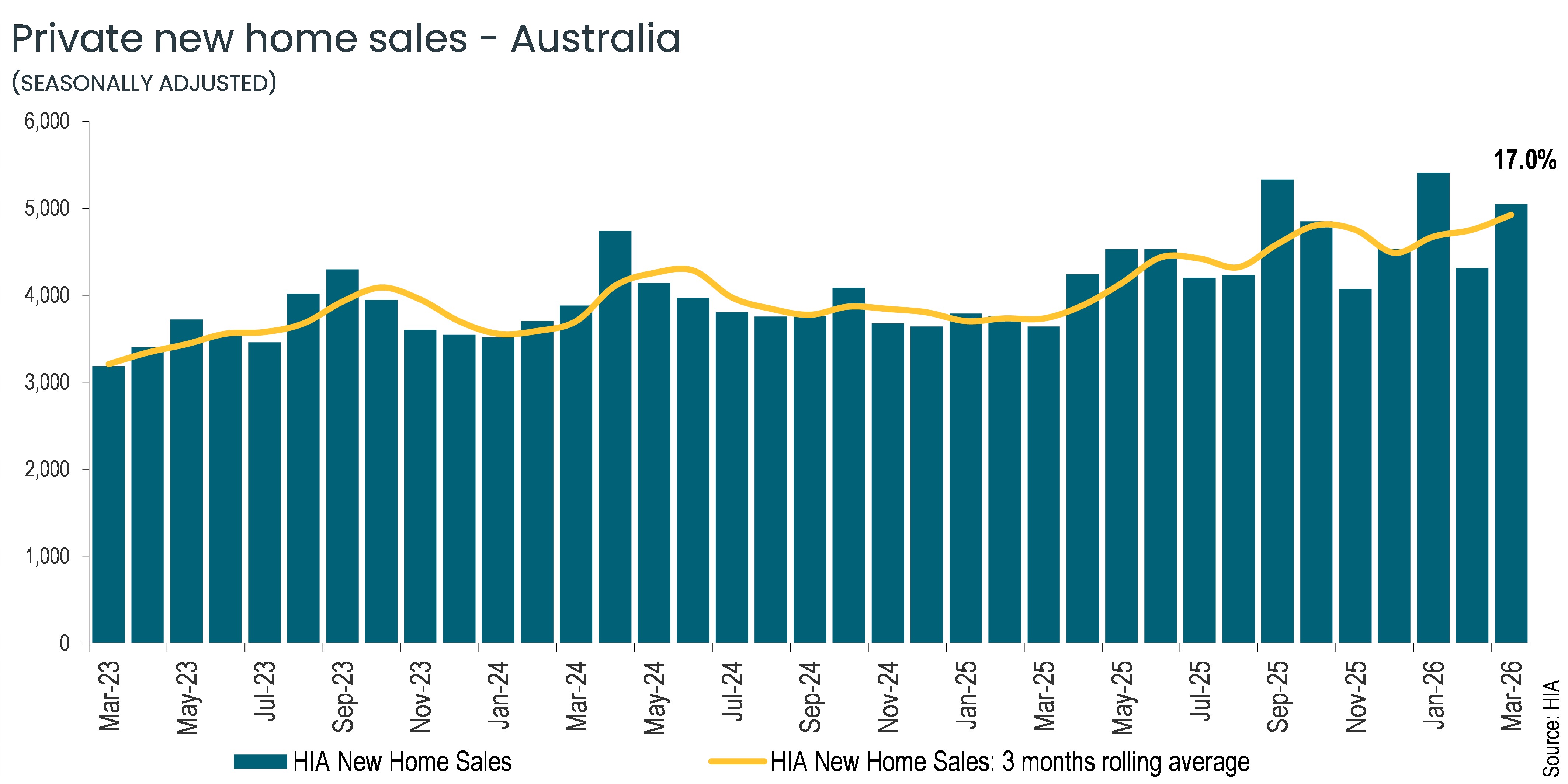
NEW HOME sales increased by 17% in March, in spite of the 0.25% rise in the cash rate and increasing fuel prices according to Housing Industry Association (HIA) chief economist Tim Reardon.

The HIA New Home Sales report is a monthly survey of the largest volume home builders in the five largest states and is a leading indicator of future detached home construction.

“Sales of new homes have been increasing since early 2025 and the disruptions of the past two months have not stopped this momentum, with sales for the March quarter 31.9% higher than at the same time last year,” Mr Reardon said.

“This is a strong result given the impact of two rate increases and heightened global uncertainty.

“This likely reflects the strength of the recovery that was underway prior to the increase in rates and the strong growth in established home prices over the past year," he said.  

“The growth in sales could partly reflect a growing involvement from first home buyers who are no longer required to take out mortgage insurance, although this data isn’t available through this data set. A jump in sales in New South Wales and Victoria is a welcome sign given their low volume of detached starts.

“More broadly, demand for housing remains strong, supported by strong population growth and low unemployment. These structural drivers continue to underpin activity, even as borrowing costs rise.

“However, the capacity to respond to this demand remains constrained. The rise in the cost of skilled labour and materials is expected to persist through 2026, while access to shovel ready land remains the key limit the number of homes that can be delivered,” Mr Reardon said.

“Input costs are also emerging as a renewed risk. More significant is the risk that higher energy costs feed into the production of materials such as steel, bricks and concrete, which would place further upward pressure on construction costs later in 2026.”

By state, Queensland recorded the largest monthly increase in March, with a 34.3% rise.

This was followed by South Australia (+22.5%), Victoria (+19.1%) and New South Wales (+11.8%) with Western Australia the only state to see a decline in new home sales contracts (-0.3%).

www.hia.com.au


ends

HIA says home building to lift in 2026 – but interest rates determine how far and how fast

AUSTRALIA’s home building industry is expected to strengthen through 2026, supported by gradually improving building approval levels and a recovery in demand, but the pace of growth will depend on how quickly interest rates can fall, according to the Housing Industry Association (HIA).

HIA senior economist Tom Devitt said new data on building approvals and inflation, released today, provides an important signal for the housing market as it enters 2026.

“Building approvals are the clearest leading indicator of future home building, and they have been gradually rising over the past year as the cash rate fell,” Mr Devitt said. 

“Building approvals data shows activity has been strengthening over the last couple of years, including a 10.1% increase in house approvals in the last three months compared to the same quarter two years earlier, and a 36.4% increase in multi-unit approvals over the same period. 

“We expect approvals to continue trending upward, which should translate into higher levels of home building activity through 2026, particularly once the impact of earlier rate cuts flows through to construction starts.

“It is anticipated that a recovery will continue in both detached housing and multi-unit construction from 2026 onward, following several years of subdued activity, especially in the apartment sector,” Mr Devitt said.

“After nearly a decade of underbuilding, the foundations are finally being laid for a broader housing recovery in 2026.

“Strong population growth, rising established home prices and an improving approvals pipeline are all pointing toward higher levels of home building over the next few years.

“While the price of land and taxes on housing are the key determinants of the number of homes to be built this year, inflation also remains a risk to a faster recovery in home building,” he said.

“The trimmed mean consumer price index for November came in at an annual rate of 3.2%, indicating that further rate cuts will be delayed.

“A few recent surprises to electricity and rental prices lifted the annual rate of inflation above the RBA’s 2-3% target.

“Property rates have also been accelerating, with each of the last five annual increases larger than the last, increasing by a further 6.2% in 2025.

“There have also been recent pressures in other items like water and sewerage utilities and government excise taxes,” Mr Devitt said.

“Price pressures have eased from their peak and many of the recent upward surprises are driven by temporary factors, like the timing of electricity rebates or domestic holiday activities.

“Nonetheless, CPI inflation is likely to remain elevated in the near term and the RBA is on the lookout for any signs of underlying inflation being reignited.

“The rate cuts delivered in 2025 provided an important tailwind for housing demand and approvals. But without further easing in borrowing costs, the recovery in home building will be more gradual than Australia needs, given the scale of the housing shortfall.”

According to HIA estimates, Australia remains short of its housing needs by close to two million homes, with population growth continuing to outpace new supply.

“This is the central challenge facing the housing market in 2026,” Mr Devitt said.

“A constrained supply of new homes is adding to upward pressure on rents, prices and inflation itself, which in turn feeds back into higher interest rates.”

“It is particularly counterproductive that the shortage of housing supply is putting pressure on inflation and interest rates, further impeding new home building.”

HIA’s outlook shows detached home building strengthening across most states in 2026, led by Queensland, South Australia and Western Australia, with New South Wales and Victoria beginning to recover after lagging earlier in the cycle.

The multi-unit sector is also expected to turn a corner from 2026, as higher established unit prices improve project feasibility and a large pipeline of approved but not commenced projects begins to move. 

“The next housing upswing is taking shape, but it will not reach its full potential unless policy settings support it,” Mr Devitt said.

“Lowering the cost of delivering new homes through planning reform, improved land supply and lower government charges will be critical if Australia is to lift housing supply without reigniting inflation,” he said.

In seasonally adjusted terms, the volume of new home approvals in the three months to November compared with the same quarter two years earlier increased the most in Western Australia, up by 71.3%.

This was followed by Queensland (+33.6%), South Australia (+29.2%), New South Wales (+24.6%), Victoria (+3.7%) and Tasmania (+0.5%). In original terms, the Northern Territory increased by 68.1% while the Australian Capital Territory declined by 47.5%.

www.hia.com.au

ends

HIA says policy changes seeing a spike in home building

THE Housing Industry Association (HIA) is observing a spike in new home building that seems to be a result of recent policy changes in several areas both financial and governmental.

“Sales of new homes for construction jumped 25.9% in September following a series of policy changes, including a cut to the cash rate in August, removal of Lenders Mortgage Insurance and easing in planning restrictions,” HIA chief economist, Tim Reardon said.

The HIA New Home Sales report is a monthly survey of the largest volume home builders in the five largest states and is a leading indicator of future detached home construction.

“The volume of new homes sold nationally increased by 25.9% in the month of September 2025. This is the largest monthly increase since the final phase of the HomeBuilder grant in March 2021,” Mr Reardon said.

“This sees sales in the September quarter a more modest 4% higher, to reach its highest quarterly volumes since October 2022.

“Sales of new homes in September were notably stronger in New South Wales and Victoria where sales have previously struggled to recover despite the cut to the cash rate. These markets have been very slow to respond to the cuts to the cash rate. 

“The rise in sales in New South Wales and Victoria could be a sign that new home building is returning to more average levels, but further data will be necessary to support this view,” Mr Reardon said.

“The cut to the cash rate is the primary driver of the rise in sales of new home this year. Other factors include low unemployment, strong population growth and rising established home prices.

“The rise in established home prices is seeing more households choosing to build a new home, because it is cheaper than an established home.

“The removal of the requirement for LMI for first home buyers has seen builders across the country report increased first home buyer activity.” He said.

“Lowering the cost of borrowing is expected to see an increase in new home building, and therefore have a positive impact on the supply of homes. Because this policy change doesn’t impact the amount a first home buyer can borrow, it doesn’t add to their risk of default.

“Around a third of all new homes are built by first home buyers and they play an important role in increasing housing supply.

“The announcement is likely to have seen more confidence in the market outlook for all households, not just first home buyers.

“Additional policy reforms including accelerated approvals processes in New South Wales through complying development pathways (CDCs) and lower infrastructure costs appear to be having a positive impact on supply.

“Further reforms to fast-track approvals as well as accelerated Environment Protection and Biodiversity Conservation (EPBC) decisions and further planning reforms could further increase supply.

“Australia will likely fall well short of the goal of 1.2 million new homes, but policy levers are starting to move in the right direction in many states,” Mr Reardon said.

This month’s increase in new home sales nationally was driven by all states, led by a 34.8% increase in Victoria.

New South Wales trailed closely behind with a 34.4% monthly increase, followed by Queensland (+25%), Western Australia (+14.2%) and South Australia (+7.5%).

www.hia.com.au

ends

New home sales remain around three-year high - HIA

NEW HOME sales in Australia are still peaking at their three-year highs.

“The volume of new homes sold (contract-to-build) nationally decreased by 1.2% in the month of August 2025,” HIA senior economist, Tom Devitt said.

The Housing Industry Association (HIA) New Home Sales report is a monthly survey of the largest volume home builders in the five largest states and is a leading indicator of future detached home construction.

“New home sales in the three months to August 2025 were 5.1% higher compared to the previous quarter,” Mr Devitt said.

“Despite the slight monthly moderation, sales in the three months to August 2025 remain higher than any previous quarter in the last three years. 

“This indicates that cuts to the cash rate are leading to a return in home buying activity, albeit very slowly.

“Demand for housing continues to increase due to elevated population growth and sustained low levels of unemployment.

“These factors have contributed to an increase in home buying activity, leading to an increase in the price of established homes,” Mr Devitt said.

“Ongoing competition for a limited stock of established homes available for purchase has seen buyers moving into new home building as an alternative.

“The supply side stimulus resulting from the Australian Government’s decision to remove the requirement for mandatory Lenders’ Mortgage Insurance (LMI) for first home buyers, will also boost new home sales.

“Around a third of all new homes are built by first home buyers and they play an important role in increasing housing supply.

“Reducing the barriers to entry for first home buyers will lead to an increase in housing supply, putting downward pressure on prices beyond the short term and increasing rates of homeownership,” Mr Devitt said.

This month’s decrease in new home sales nationally was driven by declines across all states except Victoria, where sales increased by 7.1%. The monthly declines were led by Western Australia, with sales decreasing by 7.7%, followed by Queensland (-6.7%), South Australia (-6.0%) and New South Wales (-1.2%).

www.hia.com.au

Detached house approvals up by 0.6% in July: HIA

THE Housing Industry Association has seen detached house approvals rise in July.

“The volume of detached houses approved for construction nationally increased by 0.6 percent in the month of July 2025 ahead of the 5% deposit guarantee announced last week,” HIA senior economist Maurice Tapang said.

The Australian Bureau of Statistics (ABS) yesterday released its monthly building approvals data for July 2025 for detached houses and multi-units covering all states and territories.

“Strong population growth, tight labour markets and recovering household incomes helped improve confidence in an increasing number of markets over the last 18 months,” Mr Tapang said. 

“This cyclical improvement in new home commencements will be enhanced by supply side initiatives, such as the 5% deposit scheme announced last week. Around a third of all new homes are built by first home buyers, and in the long-term, initiatives that reduce the cost of first home buyers entering the market will lead to an increase in new home commencements.

“This month’s increase in detached house approvals was broad-based across most states and territories, except Queensland and South Australia.

“This month’s increase brought the total volume of detached house approvals in Australia over the past 12 months up by 5.3% to 112,760.

“With three interest rate cuts having been delivered this year, more households are expected to return to the market to purchase a home.

“Strong demand for housing in the established market is expected to continue filtering through to the new home market, as building a new home becomes relatively more appealing,” he said.

“Multi-unit approvals decreased by 18.8% in the month of July 2025. Approvals for this segment remains volatile and at very low levels.

“The correlation between an apartment approval and commencement remains weak, as challenges with access to overseas financing, development costs, labour shortages and planning remain,” Mr Tapang said.

“In order to build sufficient housing to meet existing and growing demand, apartment construction needs to double from current levels.

“There remain upside risks to home building activity in Australia if policymakers help lower the cost of delivering new homes to market,” Mr Tapang said.

The volume of detached house approvals in the month of July 2025 in seasonally adjusted terms increased in Western Australia by 3.6%, followed by New South Wales (+3.2%) and Victoria (+1.7%). South Australia recorded a 4.6% monthly decline in detached house approvals, while Queensland fell by 3.7%. In original terms, Tasmania recorded a 48.4% increase in detached approvals, followed by the Northern Territory (+16.2%) and the Australian Capital Territory (+3.3%).

www.hia.com.au

ends

HIA says investors remain vital to increasing housing supply

“INVESTORS were responsible for 41 percent of new homes financed for construction in the past year,” Housing Industry Association’s (HIA) chief economist, Tim Reardon said this week.

The Australian Bureau of Statistics (ABS) released the Lending Indicators data for the June quarter 2025 this week, which provides the latest statistics on housing finance commitments.

“Investors are vital to the goal of increasing housing stock,” Mr Reardon said. 

“Since the 2019 election, the ABS has been reporting on the importance of investors to increasing the supply of new homes in Australia.

“Today’s data shows that in the 2024/25 financial year that the number of loans to owner occupiers for new homes declined by 1.4 percent, while the number of loans to investors increased by 3.5 percent. 

“Investors typically supply around a third of all new homes built in Australia but are a larger share of the market at present due to a lower level of activity from owner occupiers,” Mr Reardon said.

“Investors are not as adversely impacted by a rise in the cash rate, as they are not as sensitive to change in economic conditions or interest rates.

“Investors also accessed around a third of all loans for the purchase of an established home over the past six years. This is consistent with the ownership of the housing stock, which sees around a third of all homes available for rent,” he said.

“It is typical to see investors return to the market ahead of owner occupiers as they are less risk averse. We are in the middle of that cycle at present.

“Investors have been returning to the market, increasingly confident that ongoing strong population growth, tight labour markets and recovering household incomes will see the supply of homes outpaced by demand. 

“HIA’s New Home Sales Report is already revealing an increasing number of contracts for new home builds being signed by aspiring homeowners,” Mr Reardon said.

“It will be crucial for policymakers to maintain a strong pipeline of shovel-ready land – both greenfield and infill – to meet this return of housing demand and prevent housing affordability from worsening.

“Increasing taxes on investors, even when targeted at the established market, does not lead to an increase in home supply.

“This includes policies that reduce the tax imposts on those that build new homes and reduce the regulatory burden on the industry,” Mr Reardon said.

According to the HIA report, the Territories have been leading the return of investor activity in 2024/25, with loans for the construction or purchase of new homes up by 138.3 percent in the Northern Territory and 108.6 percent in the Australian Capital Territory compared with the previous year.

This was followed by gains in South Australia (+19.2%), Western Australia (+10.9%), Queensland (+7.4%) and New South Wales (+1.7%). Victoria (-0.9%) and Tasmania (-28.5%) saw the only declines in investor loans for new homes in 2024/25.

www.hia.com.au

ends